Ready When You Are.
Five case studies, each one a real decision about how AI and people work together. Read them in order, or start with the one that matches your question.
Isn’t It Chironic — Design System & Storybook
Every color, component and rule, read live from the code.
Getting Started With AI Concepts
New to the terms? A plain-language glossary explains agents, MCP, retrieval, guardrails, human-in-the-loop and more.
Isn’t It Chironic — Brand & AI Web Design System Storybook
Every color, component and rule, read live from the code. It includes:
- Color, type, spacing, elevation and motion tokens
- A page for every component, with a resizable preview in Morning and Night
- Contrast checked on every color pair
- The rules for code, written down: links, glass, clouds and more
- Accessibility notes on focus, motion and reduced motion
It is the same Storybook approach I used for the enterprise AI design system in AI Case Study 3, applied to my own brand.
Obliq — AI & Agentic Design System Figma File
This is a more refined version than the one I presented to Ecolab, developed further, to about 150–200 hours of my own time in all. It addresses:
- Trust & Uncertainty/Confidence
- Escalation & Takeover Patterns
- Notifications, Alert Rules & Escalation Policies
- AI Legal Disclosure/Disclaimer System
- Human-in-the-Loop / Agentic Workflow Patterns
All of this sits on top of the typical foundations: AI and conversational AI patterns, micro-frontend (MFE) tools and design system patterns.
Getting Started With AI Concepts
New to the terms? A plain-language glossary explains agents, MCP, retrieval, guardrails, human-in-the-loop and more.
The Principles, Built
Principles are easy to write. These are where I put mine to work: a design system in Figma, the same system in working code and the research that explains both.
Isn’t It Chironic — Brand & AI Web Design System Storybook
Every color, component and rule, read live from the code. It includes:
- Color, type, spacing, elevation and motion tokens
- A page for every component, with a resizable preview in Morning and Night
- Contrast checked on every color pair
- The rules for code, written down: links, glass, clouds and more
- Accessibility notes on focus, motion and reduced motion
It is the same Storybook approach I used for the enterprise AI design system in AI Case Study 3, applied to my own brand.
Obliq — AI & Agentic Design System Storybook
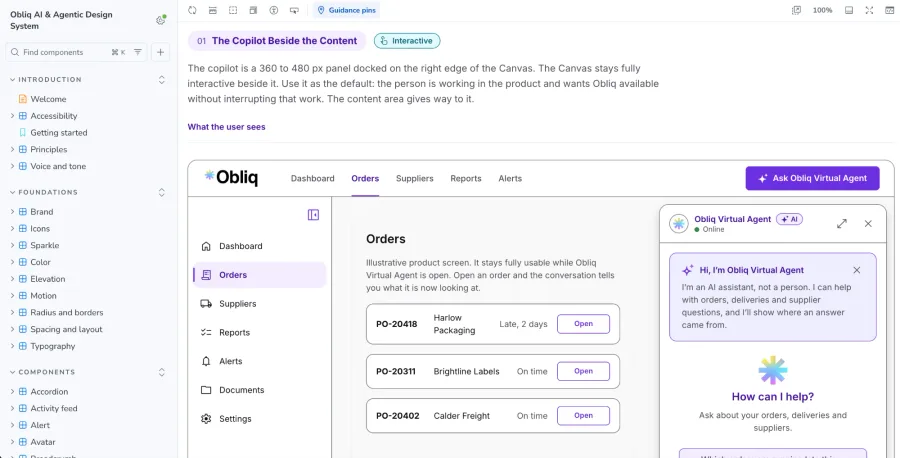
The coded version of the system, with every component and pattern working. It includes:
- Every component, with every state shown and working
- The rules beside each part, and where each one comes from
- Patterns for trust, escalation, consent and approval
- Pages marked Interactive wherever something really works
- Accessibility checked on every page, and contrast on every color pair
It is the refined, coded version of the Figma file beside it, and the plan is to draw it back into Figma once it settles. All wording about law, consent and disclosure is example wording for legal counsel to review.
Explore AI Resources and the Architecture Behind It
A working thesis on how design keeps pace with AI. It covers:
- The whole argument in one read
- One request, recorded call by call
- Who owns what, at a glance
Where a claim is a proposal and not a standard, the page says so.