















The AI, Agentic & Product Design Portfolio of Theresa Berg

A More Human Kind of Possible.

You’ve landed on my private portfolio: six case studies of conversational and agentic AI, designed and shipped inside a Fortune 500 company as its founding AI and agentic designer. It’s about the moments where AI has to earn trust, and what I decided to do about them.

Read on for the short version, or come straight in.

AI Proposes. Humans Decide.
That’s The Point of View.

I design conversational and agentic AI for enterprises: AI assistants, copilots and agents that act on a person’s behalf. The interesting work isn’t the happy path; it’s the hand-off, the disclosure, the moment a system says “I’m not sure” and gives the choice back. That’s where trust is won or lost, and it’s what these six case studies are about.

  • Conversational AI
  • AI Agents
  • Human-in-the-Loop
  • AI Disclosure & Compliance
  • Prototyping with Real Models
  • Design Systems
  • MCP Tooling
  • 0 → 1 Practice Building
18
Years in design, from front-end code to brand and identity
10+
Years building and governing design systems
1st
AI & agentic designer at a Fortune 500, where I founded the function
40%
To 50% of that company’s product portfolio running the AI assistant I designed, by July 2026

Six AI Case Studies.
Each One a Decision.

Where AI met a real person,
and what I chose to do about it.

Three views of an enterprise AI assistant over a blurred product screen: a small chat window, the copilot panel opened beside the page with suggested questions, and a panel offering Support Cases.
SHIPPED

Enterprise AI Assistant, End to End

Enterprise AI assistant · in-chat tools · hand-off to a person

A page from the enterprise reference guide on AI legal disclosure and disclaimer patterns, with real examples and two AI assistant screens beside it.
SHIPPED

Responsible AI, Written Down

AI disclosure system · human-in-the-loop review

The Interactive Agentic Architecture map in its design view: a person on the left sets the direction, a layer of agents (an orchestrator, research, design and guardrail agents) sits in the middle, a gateway runs down the center, and five owned sources stand on the right, beside the first of eight steps, It Starts With a Person.
SHIPPED

An AI-Native Design Process

A design system generated through MCP, in 80–100 hours

An intelligence platform home page with the AI assistant open beside it, showing top priority cards and an insight in the panel.
SHIPPED

Agentic AI That Notices First

Agentic loop across a spectrum of roles · autonomy thresholds

A clickable prototype of the Obliq Virtual Agent docked beside a Meridian Operations dashboard. The dashboard lists today’s top priorities and key metrics, the assistant greets the user and offers to work on the action the user presses on a card, and a Steps menu on the left lists seven steps.

SHIPPEDThe Story Across the Work

Trust Starts Before the First Prompt

A promise made must be honored. How a new AI capability becomes something people rely on: the brand and the sales story that make the promise, the product that keeps it, and the decisions an agent hands to a person.

The audit board from the design system story. A row of filters (Everything, Style Drift, Built Poorly, Not Represented, Kept on Purpose) sits above groups of small drawn screens, nineteen in all, with a count of eleven to fix, four to add and four to keep. One group of five screens is built from an older design system and one group of five from a newer core system. A dashed ring marks the part of each screen that drifted, and each screen shows its product, a Fix or Keep label and the kind of problem.

SHIPPEDA Story About Design Systems

Unifying Design Systems: People First, AI Second

How two drifting design systems and the libraries around them came together without stopping product work, and how AI can help the design system problems many enterprises share.

Ten Case Studies Across Product and Brand

I have designed enterprise software, e-commerce, gaming software, pharmaceutical websites and brand identities. Each of these ten case studies shows the problem, the decisions I made and how it turned out.

Obliq — AI & Agentic Design System Storybook
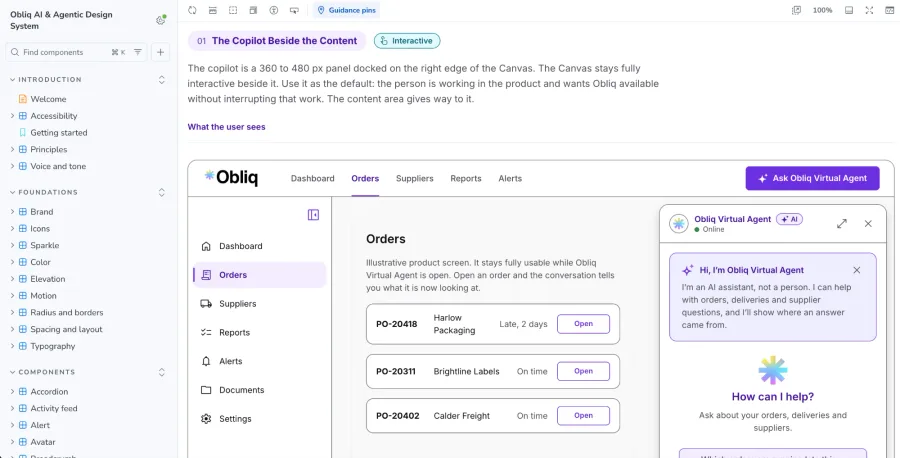
The coded version of the system, with every component and pattern working. It includes:

  • Every component, with every state shown and working
  • The rules beside each part, and where each one comes from
  • Patterns for trust, escalation, consent and approval
  • Pages marked Interactive wherever something really works
  • Accessibility checked on every page, and contrast on every color pair

It is the refined, coded version of the Figma file beside it, and the plan is to draw it back into Figma once it settles. All wording about law, consent and disclosure is example wording for legal counsel to review.

Obliq — AI & Agentic Design System Figma File
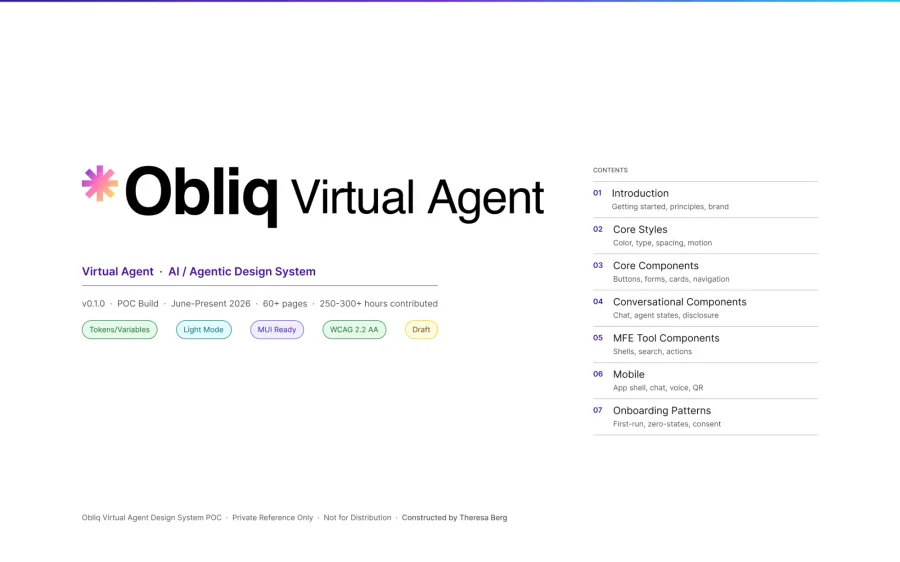
This is a more refined version than the one I first presented, developed further, to about 150–200 hours of my own time in all. It addresses:

  • Trust & Uncertainty/Confidence
  • Escalation & Takeover Patterns
  • Notifications, Alert Rules & Escalation Policies
  • AI Legal Disclosure/Disclaimer System
  • Human-in-the-Loop / Agentic Workflow Patterns

All of this sits on top of the typical foundations: AI and conversational AI patterns, micro-frontend (MFE) tools and design system patterns.

Isn’t It Chironic — Brand & AI Web Design System Storybook
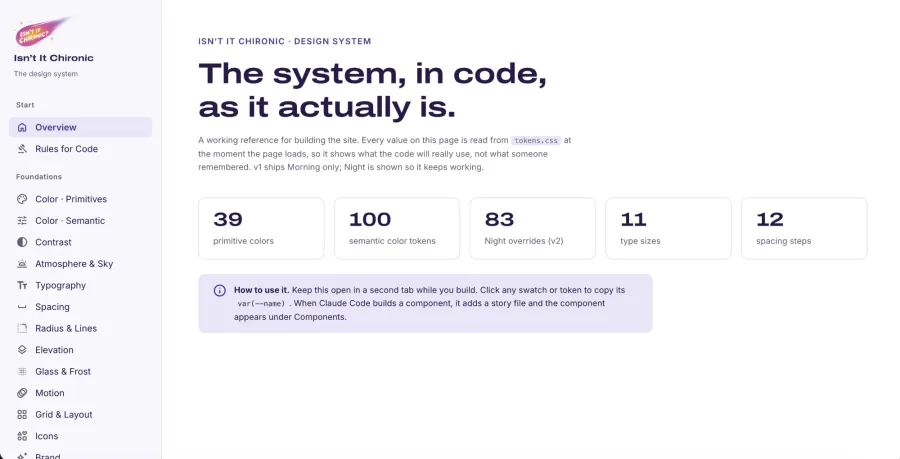
Every color, component and rule, read live from the code. It includes:

  • Color, type, spacing, elevation and motion tokens
  • A page for every component, with a resizable preview in Morning and Night
  • Contrast checked on every color pair
  • The rules for code, written down: links, glass, clouds and more
  • Accessibility notes on focus, motion and reduced motion

It is the same Storybook approach I used for an enterprise AI design system, applied to my own brand.

Getting Started With AI Concepts

New to the terms? A plain-language glossary explains agents, MCP, retrieval, guardrails, human-in-the-loop and more.